Seaweed Extraction Enzyme Trial Checklist
When an enzyme trial is under-defined, the plant learns too little from the run. When it is structured properly, your team can see whether the treatment improves extraction flow, filtration behavior, yield recovery, viscosity control, solids handling, and final ingredient consistency.
Thalrix supports seaweed processors with practical enzyme solutions for brown, red, and green seaweed extraction lines. If you are looking for an enzyme supplier for seaweed processing, this checklist will help your extraction, quality, and production teams define a trial that generates plant-floor evidence — not just lab notes.
Use it before screening a new enzyme treatment, changing raw material sources, debottlenecking filtration, or improving consistency across seasonal seaweed lots.
Request a quote
What a Good Enzyme Trial Must Prove
A seaweed extraction enzyme trial should answer commercial questions:
- Can the same raw material deliver a cleaner, more manageable extract?
- Does viscosity drop enough to improve pumping, mixing, heat transfer, or separation?
- Does the treatment improve soluble recovery without creating downstream instability?
- Are screens, filters, presses, or centrifuges easier to run?
- Does the finished ingredient stay within color, clarity, odor, mineral, and specification targets?
- Can the process be repeated across different seaweed batches?
The goal is not simply to show that hydrolysis occurred. The goal is to understand whether the enzyme step improves the operating window of your plant.
1. Define the Raw-Material Batch Before Treatment
Seaweed variability can hide or exaggerate enzyme performance. Start with a clear batch definition.
Record the incoming material
Capture:
- Seaweed species or blend
- Harvest region and supplier
- Fresh, frozen, dried, or milled state
- Particle size or cut profile
- Moisture condition
- Sand, shell, or foreign matter observations
- Storage duration and handling conditions
- Previous wash, soak, blanch, or alkaline/acid contact
Separate trial and control material correctly
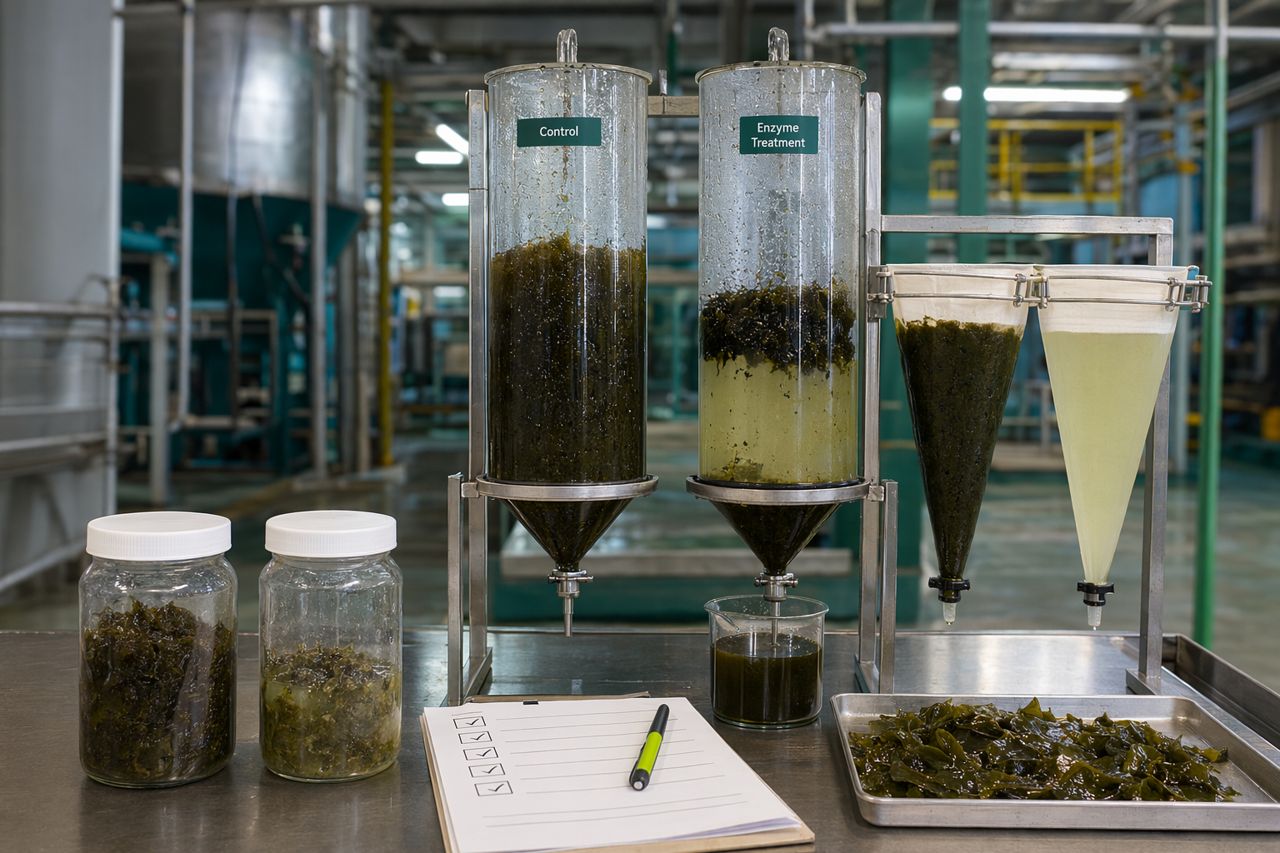
For a credible comparison, the enzyme-treated sample and control should come from the same raw-material batch and be handled under the same pre-treatment conditions. If the material is variable, split and blend before dividing into test portions.
Note seasonal or supply-chain factors
Kelp, wakame, gracilaria, ulva, and other seaweed streams can shift significantly by season. Record whether the batch represents normal supply, a difficult batch, or a premium batch. This keeps the trial from being misread later.
2. Choose the Treatment Stage with Intent
Enzymes can be used at different points in the extraction flow. The right stage depends on the target constraint.
Common treatment positions
- After washing and size reduction
- During controlled hydration or pre-extraction
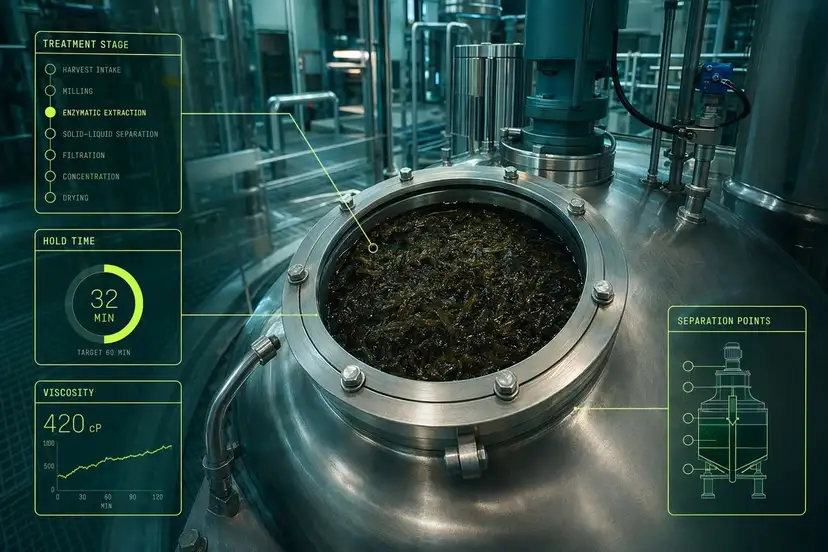
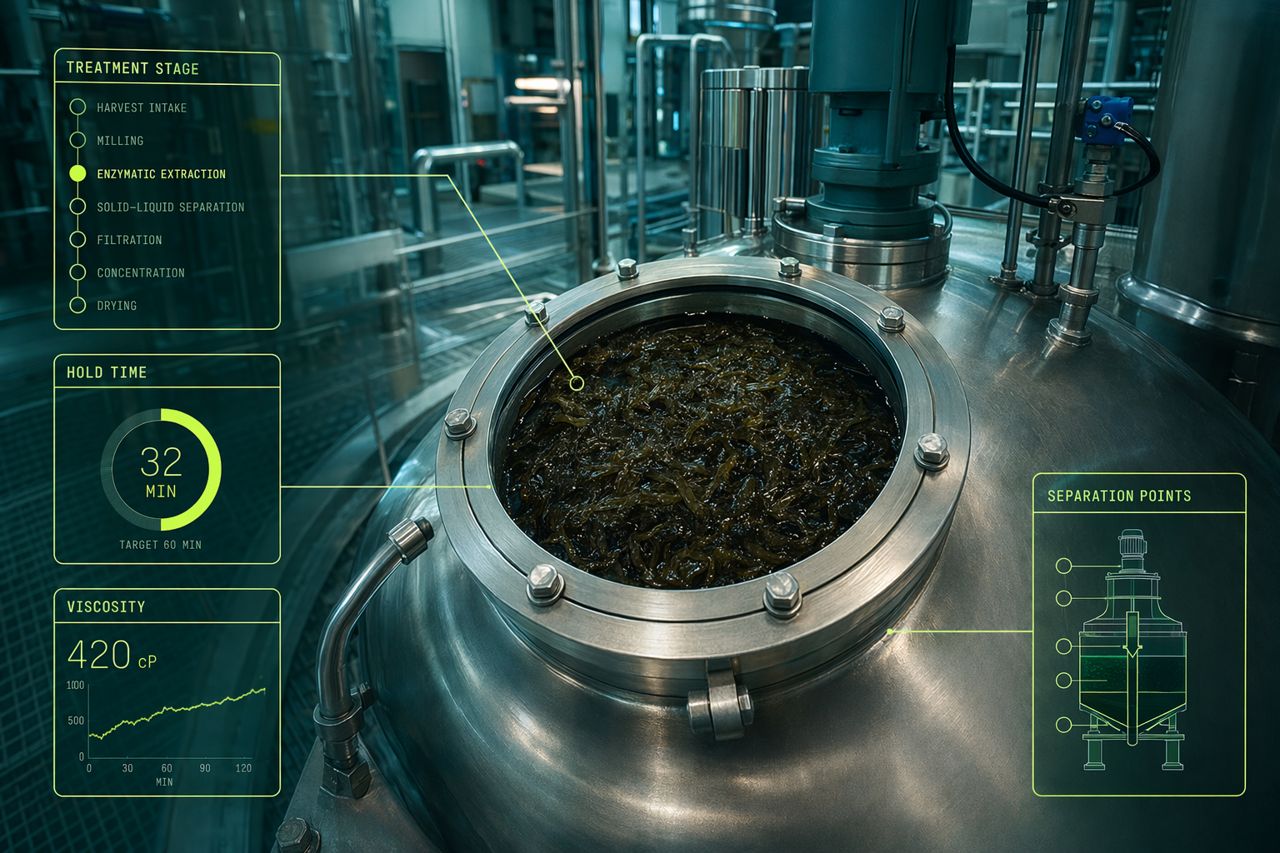
- In the main extraction vessel
- Before mechanical separation
- Before clarification or polishing
- As a viscosity-management step before concentration
Match the stage to the business problem
If the problem is poor extraction yield, test where cell-wall opening or polymer modification can improve soluble release. If the problem is heavy slurry movement, test before the highest-viscosity handling point. If the problem is filter blinding, test before the separation equipment.
The strongest trials connect the enzyme stage directly to a plant constraint: tank cycle time, screen loading, centrifuge stability, filter aid demand, extract clarity, or downstream concentration performance.
3. Set Practical Process Conditions
A useful trial should reflect what the plant can actually run.
Define the treatment window
Record:
- Slurry solids range
- Temperature target and acceptable drift
- pH target and acceptable drift
- Mixing intensity
- Hold time
- Enzyme addition point
- Order of addition for water, seaweed, chemicals, and enzyme
- Any inactivation, neutralization, or separation step after treatment
Avoid trial conditions that cannot scale
A bench trial may show a benefit under ideal mixing or unusually dilute conditions, but the result must translate to tanks, pumps, screens, and heat exchangers. Keep the process close to the plant reality unless the purpose is early screening.
4. Control the Hold Time
Hold time is one of the easiest variables to mismanage and one of the most important for seaweed extraction.
Track the full treatment clock
Define when the enzyme contact begins and ends. Include loading time, heating time, mixing delays, and transfer time if the enzyme remains active during those periods.
Compare multiple practical hold points
A strong trial may include short, medium, and extended holds. This shows whether the benefit arrives quickly, plateaus, or creates over-processing risk.
Watch for signs of over-treatment
Depending on the seaweed type and target ingredient, excessive breakdown may affect viscosity profile, gel behavior, filtration behavior, color, odor, or downstream texture. The best operating point is often the one that improves flow and recovery without compromising the ingredient specification.
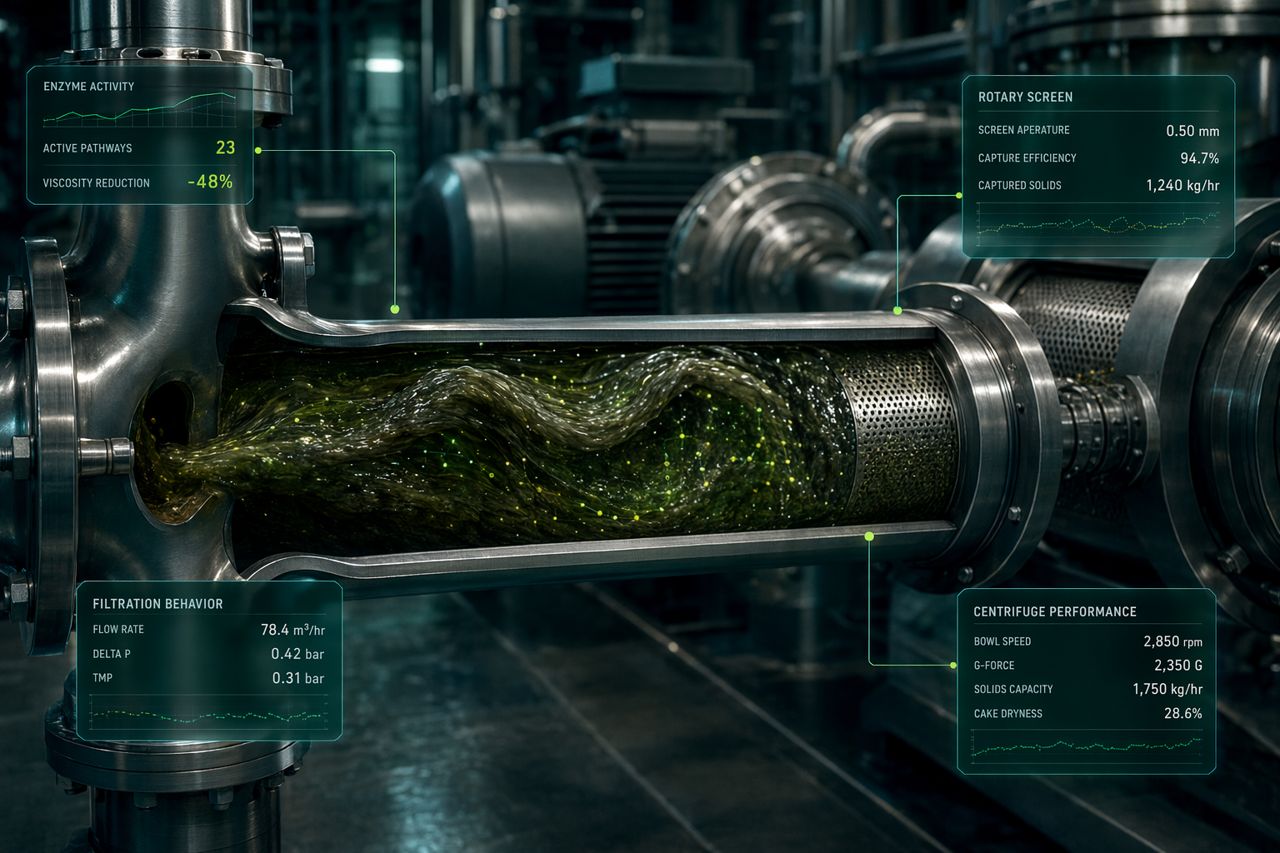
5. Measure Filtration and Separation Behavior
For many seaweed plants, the value of an enzyme is seen first at separation.
Track plant-floor handling metrics
Record:
- Screen blinding frequency
- Filter loading behavior
- Filtration time to target volume
- Press cake release
- Centrifuge feed stability
- Solids carryover in clarified extract
- Need for recycle or rework
- Operator observations on slurry movement
Compare like-for-like separation conditions
Keep mesh, filter media, feed temperature, pressure profile, centrifuge setting, and feed rate consistent where possible. If a setting changes, document why.
Look beyond clarity alone
Clearer extract is useful, but the plant also needs manageable solids, predictable throughput, and fewer interruptions. A trial should capture all three.
6. Compare Yield in a Way the Plant Trusts
Yield improvement must be tied to the product your business sells.
Define the yield basis before the run
Agree whether yield will be compared by:
- Extract mass or volume
- Soluble solids recovery
- Target polysaccharide fraction
- Dry ingredient recovery
- Finished product after concentration or drying
- Saleable specification pass rate
Include loss points
Track losses at screens, filters, centrifuges, transfer lines, evaporators, membranes, dryers, or holding tanks. An enzyme step that increases extraction but creates downstream loss may not improve net economics.
Keep the control visible
Always run a control sample or baseline process for comparison. Without a control, changes in seaweed batch, moisture, or extraction conditions can be mistaken for enzyme performance.
7. Track Viscosity Where It Matters
Seaweed extracts can move from fluid to stubborn quickly. Viscosity affects mixing, pumping, separation, heat transfer, and concentration.
Identify the key viscosity points
Measure or observe viscosity at:
- End of hydration
- End of enzyme hold
- Before separation
- After clarification
- Before concentration
- After concentration, if relevant
Connect viscosity to equipment behavior
Do not treat viscosity as an isolated number. Connect it to tank drawdown, pump load, line pressure, filter performance, centrifuge stability, evaporator behavior, and final product handling.
Protect the finished specification
Lower viscosity may improve throughput, but the finished ingredient still needs the correct functional profile. Define acceptable viscosity movement before the trial begins.
8. Check Color, Odor, and Extract Appearance
Extraction improvements are only useful if the ingredient remains acceptable to downstream customers.
Evaluate appearance consistently
Compare enzyme-treated and control extracts under the same dilution, vessel, light condition, and time after processing. Note:
- Color shift
- Haze or sediment
- Foam behavior
- Suspended fine solids
- Odor changes
- Browning or darkening during hold
Consider downstream concentration effects
Small differences in raw extract appearance can become larger after concentration, drying, blending, or storage. If your commercial product is concentrated or dried, include that step in the trial evaluation when possible.
9. Confirm Downstream Compatibility
An enzyme step should improve the extraction line without creating problems later.
Check compatibility with downstream operations
Review impact on:
- Clarification and polishing
- Membrane filtration, if used
- Evaporation or concentration
- Gelation or thickening behavior
- Spray drying, drum drying, or freeze drying
- Salt and mineral balance
- Preservative or stabilization system
- Final blend behavior
Confirm enzyme handling and shutoff strategy
Define whether the enzyme will be removed, inactivated, diluted, or carried through. The choice depends on the process, product format, and customer specification.
10. Build a Trial Data Sheet Before the Run
A simple data sheet prevents confusion after the trial.
Include these fields
- Trial date and operator
- Raw material batch identity
- Seaweed species or blend
- Pre-treatment conditions
- Enzyme product and addition point
- Treatment temperature and pH range
- Hold time
- Slurry solids range
- Mixing conditions
- Separation equipment used
- Filtration or centrifuge observations
- Extract mass, soluble recovery, or agreed yield basis
- Viscosity observations or measurements
- Color and clarity notes
- Solids handling notes
- Downstream compatibility results
- Final recommendation
Define success before starting
Set pass/fail targets for throughput, viscosity, separation, yield, color, and finished specification. This makes the decision faster once the data arrives.
When to Bring Thalrix Into the Trial
Bring Thalrix in when your team is:
- Screening enzymes for seaweed extraction
- Trying to reduce extract viscosity before separation
- Improving soluble fraction recovery
- Managing difficult seasonal seaweed batches
- Reducing filter blinding or centrifuge instability
- Building a scale-up plan from bench or pilot work
- Comparing enzyme treatment against existing chemical, thermal, or mechanical steps
Thalrix can help align enzyme selection with the actual plant constraint: controlled hydrolysis, slurry flow, cleaner separation, improved solids handling, or consistent ingredient specifications.
Request a Quote for a Seaweed Extraction Enzyme Trial
Share your seaweed type, target extract, current process stage, and the problem you want to solve. Thalrix will help you define a practical enzyme trial and quote the right treatment approach for your line.
Information that helps us respond faster
- Seaweed species or blend
- Fresh, dried, frozen, or milled format
- Target ingredient or extract type
- Current extraction stage where help is needed
- Main issue: viscosity, yield, filtration, color, solids handling, or consistency
- Batch size or planned trial scale
- Downstream equipment and finished product format
Request a quote