Reducing Water and Energy Use in Seaweed Ingredient Factories
Seaweed ingredient factories run on water movement and heat transfer. Every wash tank, extraction vessel, screen, decanter, evaporator, and CIP cycle affects the cost of finished powder, paste, hydrocolloid fraction, or liquid concentrate.
For extraction managers, sustainability is not a poster metric. It is a plant-floor constraint: keep throughput moving, protect ingredient specifications, reduce rework, and avoid pushing today’s water savings into tomorrow’s evaporation or effluent bill.
Thalrix supports seaweed processors with enzyme solutions designed for controllable hydrolysis, reduced viscosity, cleaner separation, improved solids handling, and more consistent output. For teams searching for an enzyme supplier for seaweed processing, the strongest utility gains usually come from connecting enzyme strategy to the full water and energy balance, not treating it as a standalone additive.
The real utility problem is connected
A change made at the wash line can alter extraction dilution. A change in extraction temperature can shift viscosity and downstream pump load. A change in screening performance can affect evaporation energy, fouling, and effluent solids.
The practical question is not simply, “Can we use less water?” It is:
- Can we use less fresh water without carrying grit, salt, or fines into extraction?
- Can we lower thermal demand without slowing hydrolysis or separation?
- Can we recirculate process water without destabilizing color, odor, conductivity, or microbial controls?
- Can we reduce evaporation load without increasing viscosity beyond pumpable limits?
- Can we send cleaner streams to effluent treatment with fewer suspended solids and less variation?
That is where controlled enzymatic processing can help. By opening seaweed structure and managing viscosity earlier, the plant can often move liquid and solids with less resistance and fewer corrective loops.
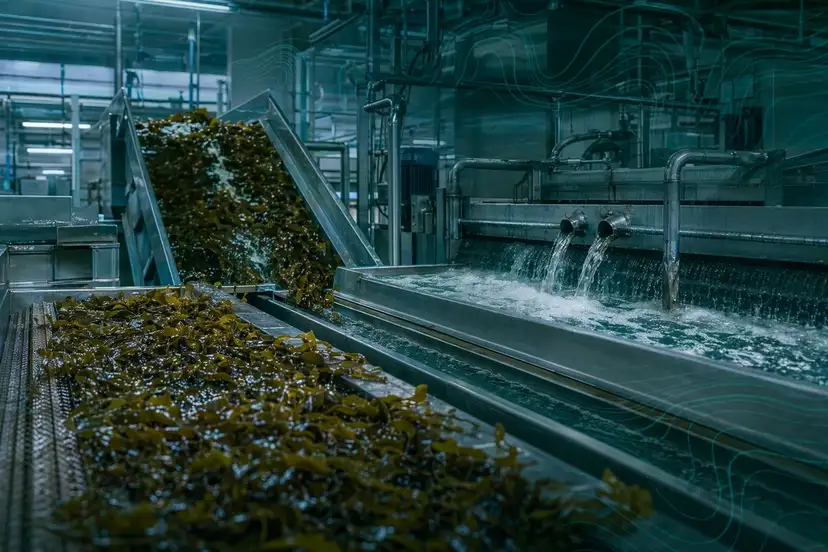
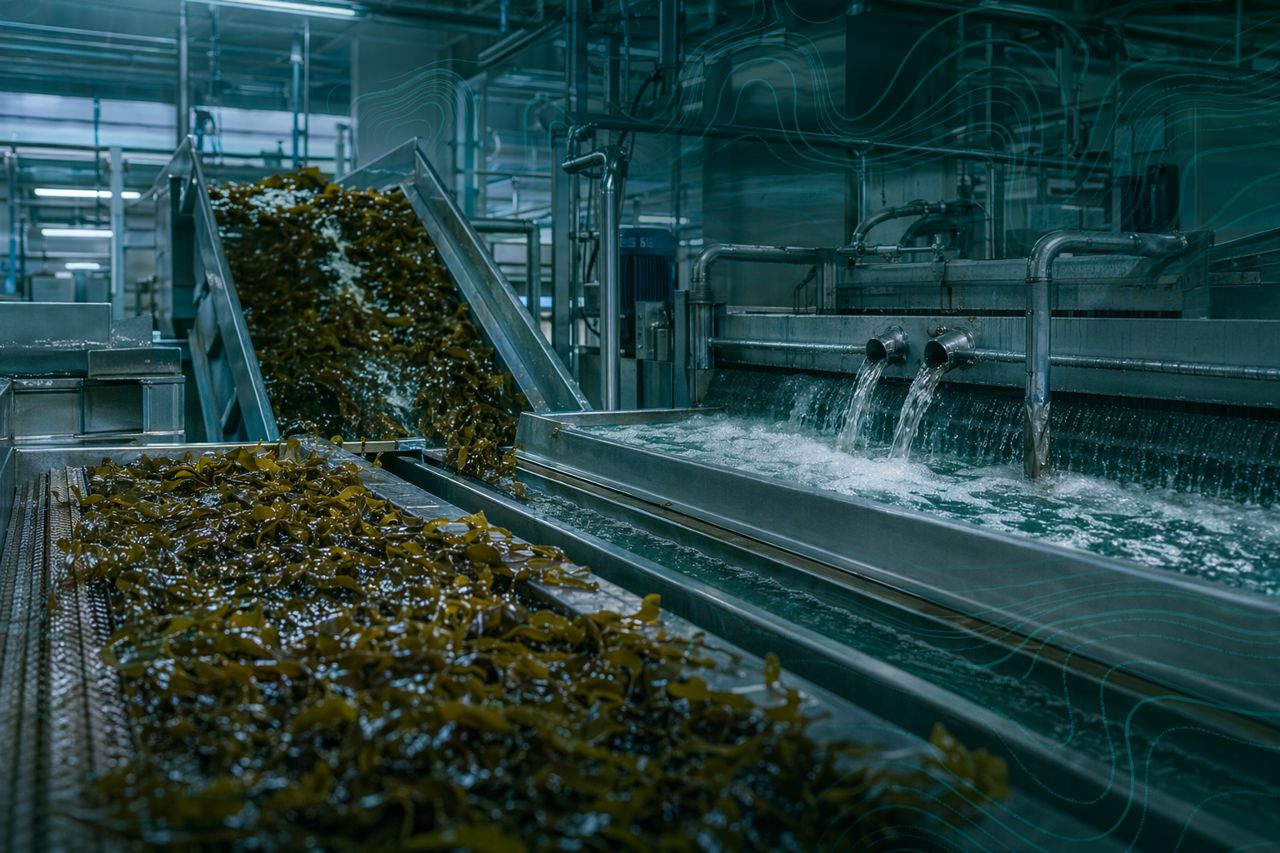
1. Washing: reduce dilution without moving the problem downstream
Raw seaweed brings sand, salts, shell fragments, biofilm, and variable surface moisture. Washing is necessary, but excessive washing can add avoidable water volume to the process.
A practical wash-water reduction program should focus on:
- Counter-current washing rather than single-pass flooding
- Better drainage time before milling or extraction
- Screening of coarse debris before high-water contact steps
- Conductivity targets that match the ingredient specification, not a generic rinse target
- Clear separation between dirty wash loops and extraction-grade water loops
The main risk is false economy. If wash water is cut too aggressively, mineral load and fines can move into extraction. That can complicate viscosity control, separation, evaporation, and final specification compliance.
2. Extraction temperature: heat only where it creates value
Many seaweed extraction lines carry legacy temperature settings. They were often chosen because they kept the process moving under worst-case raw material conditions.
But high temperatures can be expensive in three ways:
- Direct steam or thermal energy demand
- Increased cooling burden before downstream steps
- Greater risk of fouling, color shift, or specification drift in sensitive fractions
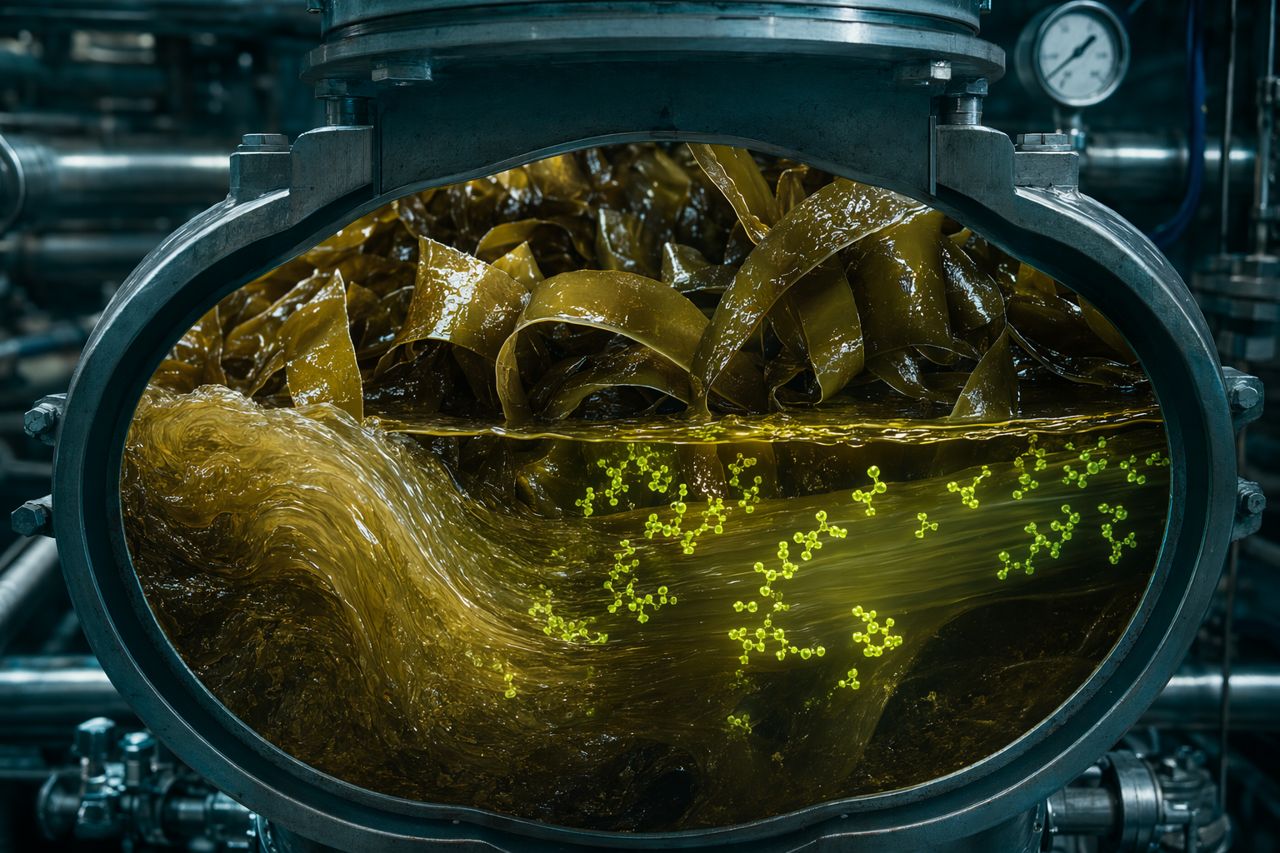
Enzyme-assisted extraction can create a wider operating window. When hydrolysis is controlled, processors may be able to improve cell opening, reduce viscosity, and support release of target fractions under milder conditions than a heat-only approach.
The goal is not simply “lower temperature.” The goal is a stable extraction profile that meets yield, separation, and ingredient quality targets with less thermal stress.
3. Viscosity control is an energy strategy
Viscosity is often treated as a processing nuisance. In reality, it is a utility driver.
High or unstable viscosity can increase:
- Pump power demand
- Mixing time
- Heat transfer resistance
- Screen blinding
- Decanter or centrifuge load
- Hold time before evaporation
- CIP frequency after fouling events
A Thalrix enzyme program can be positioned around targeted substrate breakdown and controlled hydrolysis. In practical terms, that means helping the plant create a more pumpable slurry or extract, with cleaner liquid-solid separation and more predictable solids handling.
Better viscosity control does not just help one vessel. It can improve how the entire line breathes.
4. Recirculation works only when the stream stays predictable
Water recirculation is attractive, but it can fail when the returned stream brings back too much variability. In seaweed processing, returned water can carry salts, soluble organics, fines, color bodies, and odor-active compounds.
Before increasing recirculation, extraction managers should define control points for:
- Conductivity
- Suspended solids
- Clarity or turbidity
- Soluble solids
- Odor and color impact
- Microbial management requirements
- Compatibility with the next extraction batch
Enzymes can support recirculation indirectly by improving separation and reducing the load of poorly handled solids. Cleaner split streams are easier to reuse, treat, or concentrate.
5. Evaporation load: the cost of carrying extra water
Evaporators are often where upstream dilution becomes visible as a utility cost. Every extra unit of water carried forward must be heated, evaporated, condensed, or otherwise removed.
To reduce evaporation load, plants typically look at:
- Higher extraction solids where pumpability allows
- Improved drainage of wet solids
- Better clarification before concentration
- Reduced rework from off-spec intermediate streams
- Heat integration between hot and cold process flows
However, pushing solids too high can backfire if viscosity rises sharply. A controlled enzyme approach can help define a more workable concentration window: less water to remove, without creating a slurry that overloads pumps, screens, and heat exchangers.
6. Effluent: lower volume is not enough
A factory can reduce water use and still create a difficult effluent stream. Effluent cost is driven by volume, strength, solids loading, variability, and treatment compatibility.
Useful improvements include:
- Keeping sand and heavy debris out before extraction
- Improving primary separation after hydrolysis
- Avoiding excessive breakup of solids where it creates fine particles that are harder to remove
- Preventing repeated dilution and concentration cycles
- Creating steadier side streams for treatment or valorization
Cleaner separation in the main process can reduce the burden on wastewater systems. It can also make sidestream planning more commercially realistic.
7. Heat recovery: easier when the process is stable
Heat recovery depends on predictable streams. If viscosity, fouling tendency, solids loading, and flow rate swing from batch to batch, heat exchangers become harder to operate and maintain.
A stable enzyme-assisted extraction profile can make heat recovery more practical by helping the plant maintain:
- More consistent flow behavior
- Lower fouling pressure at key transfer points
- Cleaner liquid fractions
- More predictable hold times
- Better scheduling between hot extraction and cooler feed streams
In a seaweed plant, heat recovery is not just an equipment project. It is a process stability project.
Where Thalrix fits
Thalrix works with seaweed ingredient processors to identify enzyme touchpoints where hydrolysis control can support water and energy goals without compromising specification.
Typical focus areas include:
- Raw seaweed maceration and extraction support
- Viscosity reduction before screening or decanting
- Cleaner liquid-solid separation
- Solids handling improvement before drying or disposal
- Process water quality improvement through better split streams
- Batch consistency across seasonal seaweed variation
We do not start with a generic enzyme recommendation. We start with the plant reality: raw material, extraction target, tank residence time, temperature window, separation equipment, evaporation limits, and final ingredient specification.
Practical audit checklist for extraction managers
Use this checklist to identify where utility reduction may be hiding inside process control.
| Plant area |
What to check |
Why it matters |
| Washing |
Conductivity, debris removal, drainage time |
Avoids carrying excess water and mineral load into extraction |
| Milling or size reduction |
Particle size consistency, fines generation |
Influences hydrolysis behavior, separation, and effluent load |
| Extraction |
Temperature, viscosity, residence time, mixing |
Sets the main energy profile and release efficiency |
| Enzyme step |
Dose strategy, contact time, temperature fit, stop point |
Supports controllable hydrolysis rather than uncontrolled breakdown |
| Screening and decanting |
Solids capture, blinding, centrate clarity |
Determines rework, evaporation load, and effluent burden |
| Evaporation |
Feed solids, fouling, heat integration |
Converts upstream dilution into measurable energy cost |
| Effluent |
Volume, suspended solids, strength, variability |
Drives treatment cost and compliance risk |
Embedded faceless explainer video
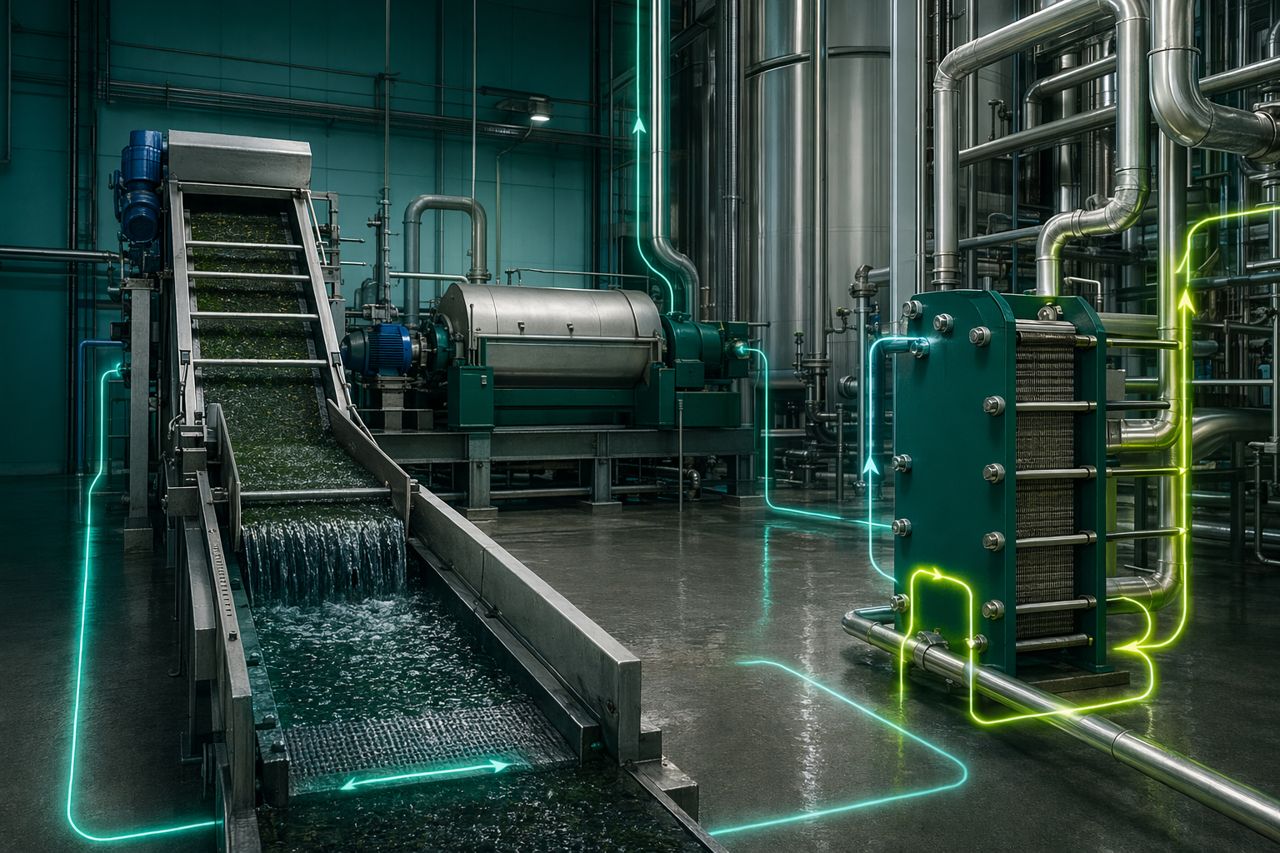
A one-minute faceless explainer video is embedded on this page. It visualizes the utility pathway from raw seaweed washing through enzyme-assisted extraction, viscosity control, separation, evaporation, effluent reduction, and heat recovery. The style is industrial, cinematic, and plant-floor focused: dark extraction vessels, kelp ribbons, luminous enzyme-pathway particles, seawater contour lines, and animated flow metrics without avatars or presenters.
The commercial target: lower utilities without losing throughput
Water and energy reduction must protect the factory’s commercial priorities:
- Maintain extraction throughput
- Reduce avoidable dilution
- Keep viscosity within equipment limits
- Improve separation consistency
- Reduce rework and off-spec intermediates
- Lower evaporation and effluent pressure
- Produce ingredients that meet agreed specifications batch after batch
That is the difference between a sustainability idea and a bankable process improvement.
Talk to Thalrix about your utility-reduction target
If your seaweed ingredient plant is trying to reduce water use, energy demand, evaporation load, or effluent variability, Thalrix can help evaluate where enzyme-assisted processing may fit.
Request a quote through the on-site form and share your raw material, extraction target, equipment train, current bottleneck, and desired specification. We will respond with a practical starting point for discussion.